
DUBAI PROPERTY INVESTMENT
The Dubai Property Discount Trap: Why 8% Off Doesn’t Always Mean a Better Investment
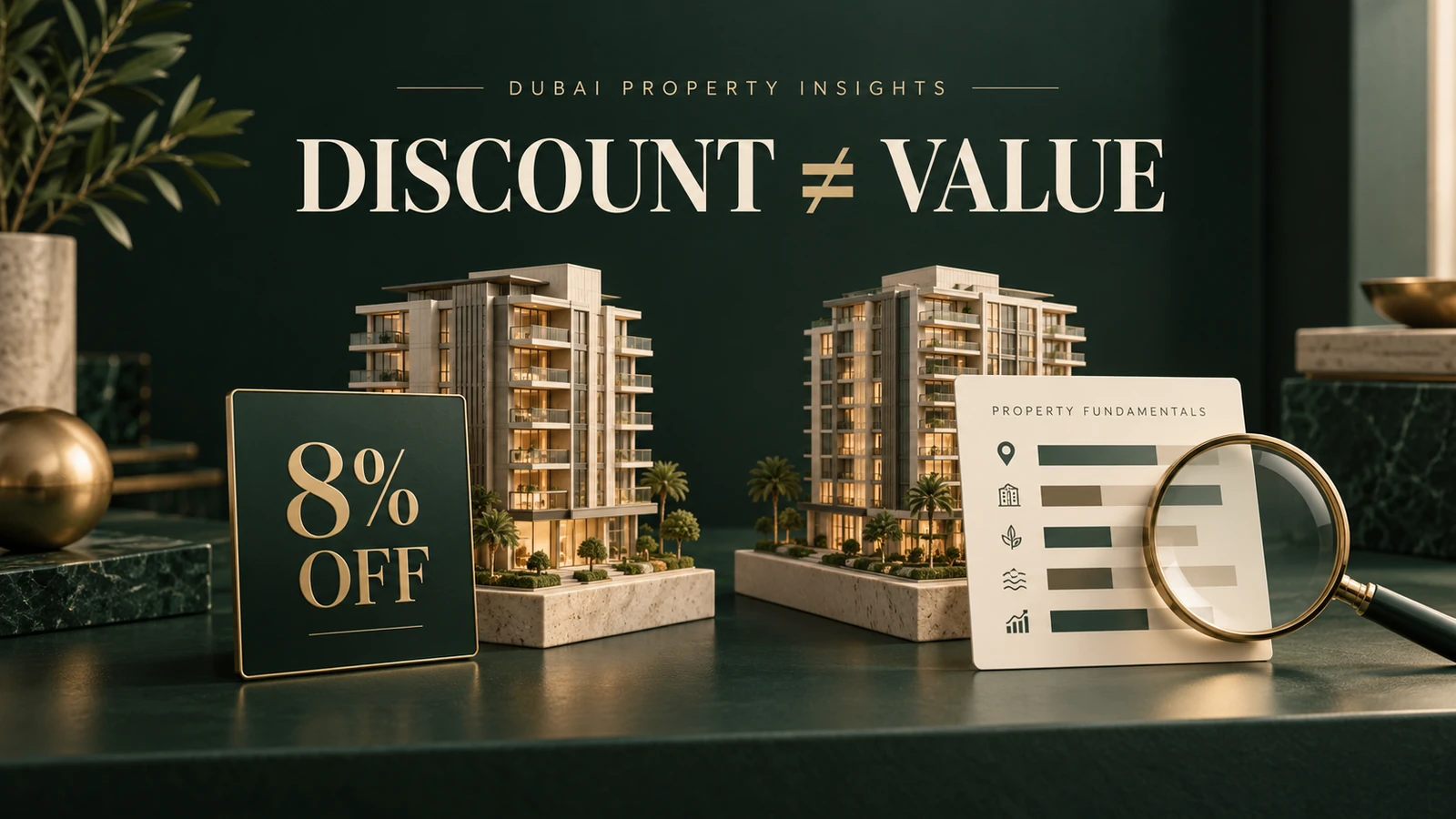
A buyer will tell me, “I’m getting this property for AED 1 million there, so why should I pay more here?”
But that’s like asking why a BMW costs more than a Toyota just because they’re parked next to each other.
A lower price only means a better deal when you’re actually comparing the same thing.
And this is where I see many Dubai property investors make one of their biggest mistakes.
They compare the prices BEFORE comparing the properties.
One developer offers a 5% discount. Another offers 8%. A third promises an attractive payment plan.
Naturally, the property with the biggest discount starts looking like the smartest investment.
But here’s something worth asking:
What if the property offering you the biggest discount was never worth its original asking price?
That’s the discount trap.
And there’s actually a psychological reason why discounts feel so attractive.
A meta-analysis of 20 published marketing studies, published in the Journal of Retailing, found that the way discounts are presented influences how much consumers believe they’re saving. Percentage discounts had a stronger effect on perceived savings than equivalent monetary discount amounts.
“The way a discount is presented can influence how valuable it feels. It doesn’t establish what the underlying property is worth.“
And understanding that difference could change the way you evaluate your next Dubai property investment.
An 8% Discount Doesn’t Mean You’re Buying 8% Below Market Value
Imagine you’re considering an off-plan apartment in Dubai.
The developer originally lists it for AED 1.2 million.
Then comes the offer.
8% DISCOUNT. LIMITED INVENTORY.
Suddenly, the price drops to AED 1,104,000.
You’ve apparently saved AED 96,000.
Sounds like a great deal, right?
But here’s the question I would ask before recommending that property:
What are comparable apartments actually selling for?
Because if similar apartments in the area are already available for around AED 1.05 million to AED 1.1 million, that discount hasn’t necessarily saved you anything.
You might still be paying more than the property’s reasonable market value.
These figures are hypothetical, but the underlying mistake is one I regularly see buyers make.
The developer controls the advertised asking price.
The market helps determine whether that price is justified.
And those are two very different things.
A discount tells you how much the seller has reduced the asking price. It doesn’t tell you what the property is worth.
Sometimes, the Discount Is Telling You Something About the Property
One thing I’ve learned while evaluating Dubai off-plan projects is that not every unit in a development has the same investment potential.
Even within the same building, two apartments can have very different levels of demand.
Consider two one-bedroom apartments.
Apartment A has an awkward layout, limited natural light and a less desirable position within the building.
Apartment B has a more practical layout, better positioning and features that may appeal to a wider range of future tenants and buyers.
Now imagine Apartment A is being offered with a substantial discount.
Which would you choose?
The cheaper apartment might still make financial sense at the right price.
But you need to understand why it’s cheaper.
Perhaps it’s slower-moving inventory. Perhaps the developer is running a genuine promotional campaign. Perhaps the incentive is designed to encourage purchases under a particular payment plan.
Or perhaps the unit has characteristics that make it less attractive.
The point isn’t that discounts are bad.
It’s that you should investigate the reason for a discount before treating it as an opportunity.
And there’s another factor that makes this especially important for investors.
You Could Save Money on the Entry and Lose That Advantage at the Exit
Let’s say you purchase a discounted apartment today.
You’ve negotiated a lower entry price, and you’re feeling pretty good about the deal.
A few years later, you decide to sell.
But now you’re competing with other units in the same development.
Some have better layouts. Some have better views. Others might be more attractive to the people who actually want to live in that community.
Your apartment may need to be priced more aggressively to attract a buyer.
Suddenly, the discount that looked so impressive at the beginning doesn’t seem quite as valuable.
You saved money when you entered the investment. But what happens when you try to exit?
As I often explain when discussing property investments:
“It’s more about planning your exit, not just your entry.”
— Shashank Jain
This is why I don’t evaluate properties based on the purchase price alone.
I also want to understand the rental demand, resale activity, competing inventory and the type of tenant or buyer the property could attract in the future.
Of course, future rental income and resale prices are never guaranteed.
But we can still make more informed decisions by examining the available evidence instead of relying entirely on a developer’s marketing material.
Because my job isn’t simply to help an investor purchase a property.
It’s to help them think through what owning that property could mean over time.
How I Actually Compare Two Dubai Property Investments
When someone brings me two projects and asks which is the better investment, I don’t begin by comparing their advertised discounts.
I want to understand five things.
1. What is the real market price?
The first thing I examine is the price per square foot (PSF) and comparable property transactions.
But comparing PSF alone isn’t enough.
A premium branded residence and a basic residential building may be located in the same area without offering the same product.
Likewise, two apartments may have the same number of bedrooms but significantly different layouts, sizes, views and amenities.
I want to understand what the investor is receiving for the price they’re paying.
The correct comparison isn’t simply AED 1 million versus AED 1.2 million. It’s what each AED 1 million or AED 1.2 million actually buys you.
You can also examine registered sales and rental transaction data through the Dubai Land Department’s Real Estate Data portal.
2. Is there genuine rental demand?
For an investor expecting rental income, I want to know what comparable properties are renting for.
Not merely what the developer projects.
What are tenants actually paying for similar units?
What type of tenant is attracted to this location?
And what ongoing expenses could reduce the income an investor ultimately receives?
For example, an apartment advertised with an attractive gross rental yield may look less impressive after considering service charges, maintenance, management costs and possible vacancy periods.
The Dubai Land Department’s Service Charge Index is one useful source for checking approved service charges where available.
The attractive number on a brochure isn’t necessarily the number that ends up in your pocket.
3. What will the competing supply look like?
This is particularly important when evaluating off-plan projects.
Suppose you’re purchasing a one-bedroom apartment that is scheduled for handover in three years.
What other developments are expected to be completed around the same period?
How many similar apartments might be competing for tenants?
Will your unit have something that distinguishes it from the surrounding inventory?
Nobody can predict future supply and demand with certainty.
And even announced supply needs to be interpreted carefully.
According to Knight Frank’s Dubai Residential Market Review Q4 2025, 64% of scheduled homes were completed on time in 2025, compared with 50% in 2024.
That’s an improvement, but it also highlights something important.
Scheduled handovers and actual completions aren’t always the same thing.
This doesn’t tell us whether any particular project will be delayed. But it does mean investors should distinguish between announced future supply and the inventory likely to enter the market around their property’s handover date.
Both competing supply and possible construction delays deserve attention.
Ignoring these factors entirely is not an investment strategy.
For off-plan projects, investors can also use the Dubai Land Department’s Project Status Enquiry (Mashrooi) to review officially reported project details and construction progress.
4. Does the individual unit actually make sense?
This is something I pay particular attention to.
A good project doesn’t automatically mean every unit within that project is a good investment.
Floor level, layout, usable space, views, positioning and competing unit types can all influence a property’s appeal.
Sometimes, spending more for a better-positioned unit may be justified.
Other times, the premium simply isn’t worth paying.
That’s why I prefer evaluating the specific unit, not just the developer’s brand or the project’s reputation.
5. What does the exit look like?
Finally, I ask something that I believe every investor should think about:
Who is likely to buy this property from you in the future, and why would they choose it?
Is it attractive to end-users?
Would it appeal to other investors?
Is there evidence of resale activity in the area?
What competing properties might be available when you eventually decide to sell?
What would happen if the market didn’t appreciate as expected?
The answers won’t eliminate investment risk.
But they can help you identify weaknesses before you’ve committed a significant amount of capital.
So, Should You Avoid Discounted Dubai Properties?
Absolutely not.
A genuine discount on an attractive property can be an excellent opportunity.
I’ve seen situations where the entry price of a property made the investment particularly interesting relative to other opportunities in the area.
But that conclusion comes after evaluating the property, not before.
A developer offering 8% off doesn’t automatically mean the project is bad.
And a developer offering no discount doesn’t automatically mean the project is good.
Both conclusions would be shortcuts.
Instead, ask yourself:
If the developer removed the word “discount” from the brochure tomorrow, would I still want to buy this property at the final asking price?
Think about that.
Would the location still appeal to you?
Would the unit still make sense?
Would the rental economics still be attractive?
Would you still be comfortable with the entry price and potential exit?
If your entire investment thesis depends on the percentage written next to the discount, you probably need to investigate further.
The Best Deal Isn’t Always the Cheapest Property
Dubai offers investors many different types of opportunities, from off-plan apartments and townhouses to villas and commercial properties.
But no two investments should be treated as identical simply because their prices appear similar.
My approach is to understand the numbers, the location, the demand, the project and the specific unit before making a recommendation.
And sometimes, that means telling an investor that the cheaper option isn’t necessarily the better one.
Because when you’re investing a million dirhams or more, your goal shouldn’t be to win a negotiation over the largest discount.
Your goal should be to make a property decision that still makes sense long after the discount has been forgotten.
Comparing Two Dubai Properties? Let’s Look Beyond the Discounts.
I’m Shashank Jain, a Dubai real estate advisor specialising in off-plan property investments.
If you’re currently considering two or more Dubai properties and aren’t sure which one makes better financial sense, I can help you understand what deserves a closer look.
Send me the project names, quoted prices and payment plans you’re comparing.
We can look at the entry prices, market comparisons, rental potential, supply and resale considerations rather than making the decision based on the biggest advertised discount.
DM me “INVEST” on Instagram, or use the contact page and let’s look at your options together.
Investment outcomes depend on individual circumstances and market conditions. The examples in this article are illustrative and do not guarantee rental income, appreciation or resale results.
START A CONVERSATION
Thinking about investing in Dubai real estate?
If you’re comparing opportunities, trying to understand a particular property, or simply figuring out where to begin, you can speak with me directly.
Tell me what you’re looking at, what you’re trying to achieve, and where you’re currently stuck.
Give the conversation a starting point.
Choose what matters to you. Review your message, then open WhatsApp.
Leave a Reply